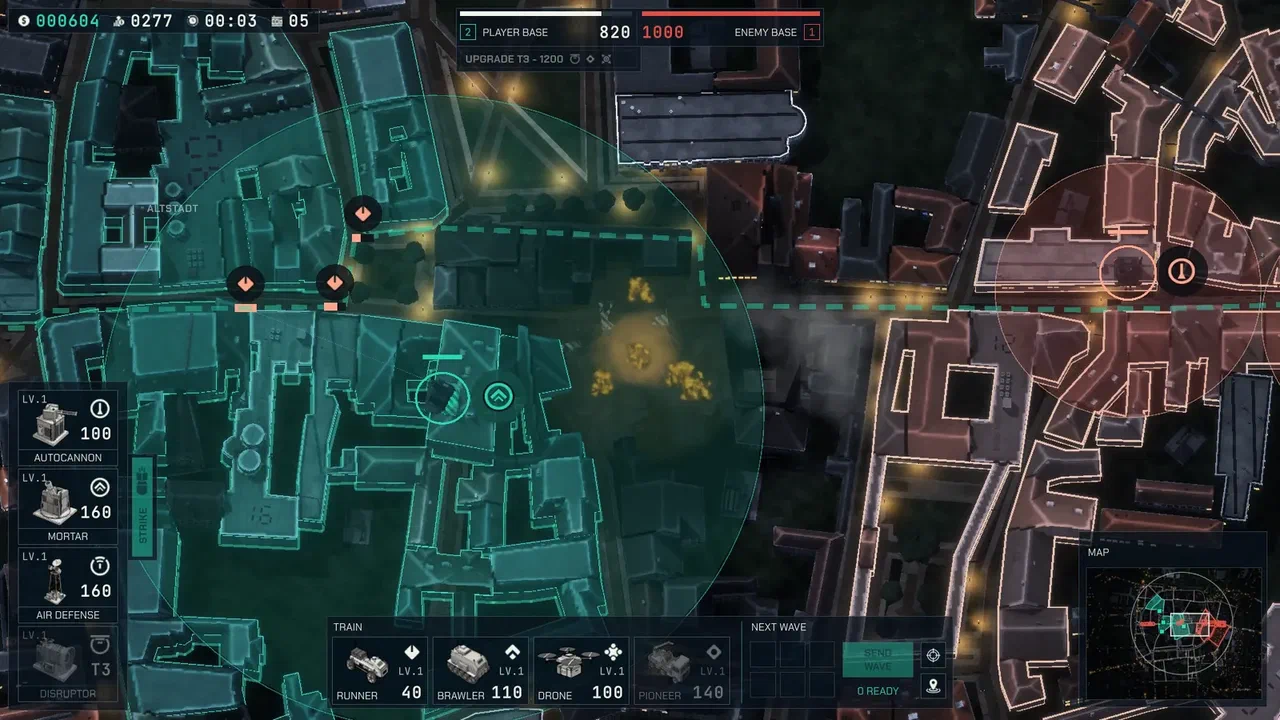
For the past months most of my time has gone into one project: Hardpan, a strategy game played on the real streets of St. Pölten, the town I live in. Today the first devlog went out.
The idea is simple to say. You defend your blocks and send convoys into your opponent’s, and both come out of one wallet. The streets are real, built from OpenStreetMap, and the street network is the whole game: ground units can only drive where the town has roads. Close a road and every route bends around it, yours too.
Under the hood it’s the kind of project I enjoy most, because it crosses everything I’ve done before: design, programming, product decisions, and a fair amount of geometry.
Data made for people
The first lesson surprised me. OpenStreetMap is an extraordinary piece of work, mapped by volunteers street by street. But it was drawn for people, and people fill gaps without noticing. A machine takes it literally.
My own tool made that worse. To stop units from falling off a bridge onto the road below, I lifted every bridge one level up. It worked, and it also cut every bridge off from the street it continues. The town’s road network fell apart into 132 pieces. A person reading the map would never notice. The game couldn’t get a single unit across the river.
That pattern isn’t specific to maps. Most data we inherit was made for someone else’s purpose, and it holds up until something reads it more literally than its authors ever did. (I wrote about a related assumption, satellite navigation as a fact of nature, in The End of GPS as a Reliable Default.)
The feature nobody saw
The second lesson is a product lesson, and it stung more. The best thing in the game, I think, is that the city changes during a match: a strike closes a street, buildings come down, convoys reroute. In the first playtest, one of three testers noticed the city had changed at all.
Years of product work taught me that the feature you’re proudest of is often the one users can’t see. Knowing that doesn’t make it easier when the feature is yours and you built it alone. The fix isn’t more features. It’s making the one that matters impossible to miss, and that’s what I’m working on now.
The full story
The devlog goes through all of it: what OpenStreetMap gives you, the bridges, how wide a street really is, roofs, and why the street network is the game. There’s an 11-minute video and a written version with the pictures.
Read devlog #1: Turning a real city into a battlefield →
Hardpan is in pre-alpha and made by my studio, Gorillabyte. If you’d like to follow along, there’s a monthly email on hardpan-game.com.